A Filename Mutation Reconstructs a Dangerous PHAR Archive
The plugin exposes `dnd_codedropz_upload` through unauthenticated `admin-ajax.php`; a companion action issues a usable nonce to anonymous callers, so no WordPress account is required. In version 1.3.9.8, the handler checks the multipart filename before Contact Form 7 removes control characters. A name with a control byte inside `phar` therefore passes the ASCII, blacklist, allowlist, and MIME-pattern checks as an allowed image. The final normalization silently removes that byte and writes `poc.phar.jpg`, or literal `poc.phar` when a form permits `filetypes:*`. Direct PHP execution requires a compatible Apache handler and ineffective upload-directory denial. The default `.jpg` result instead requires another attacker-influenced `phar://` file-operation sink and a viable POP chain. Those dependencies matter, but the upload still places an intact attacker-controlled PHAR on the server.
BitFire FREE Stops Automated Delivery and Malicious Upload Content
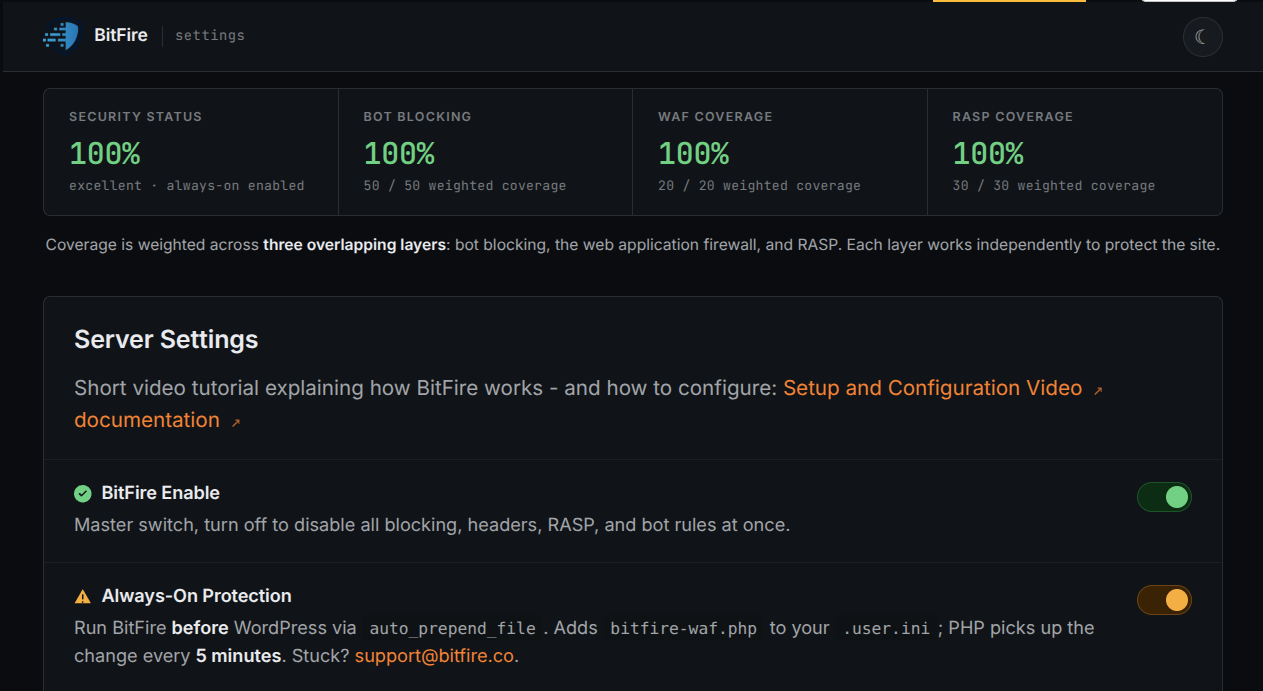
BitFire Bot Protection evaluates the client before the vulnerable plugin runs. Unknown or restricted automation cannot POST to the public AJAX actions, mint the nonce, or submit the multipart upload unless it is explicitly allowed; clients presenting as browsers must pass lightweight JavaScript verification. This blocks common scripted exploit delivery at the request boundary, while a verified browser or allowlisted integration still remains subject to later controls. The BitFire WAF then evaluates what the upload contains. Its malicious-upload inspection rejects web shells, executable PHP, malicious code, and other dangerous payloads before the vulnerable handler writes them. A weaponized PHAR polyglot carrying PHP and serialized exploit material crosses that inspection boundary. These request protections are available in BitFire FREE for eligible non-commercial sites; commercial use requires the appropriate license.
BitFire PRO RASP Prevents Unauthorized PHAR Creation
BitFire PRO RASP provides the independent runtime boundary that remains effective if a human-controlled client reaches the AJAX handler or an upload evades request filtering. Filesystem protection observes the attempted write and prevents an unauthenticated requester from creating the attacker-controlled PHAR archive. That blocks the dangerous on-disk primitive itself: there is no literal `.phar` for a permissive PHP handler to execute and no disguised `.phar.jpg` archive for a later `phar://` operation to parse. RASP does not repair the plugin's filename ordering or sanitize the supplied name. It denies the unauthorized filesystem outcome after request processing begins, preventing this vulnerable upload path from establishing executable PHP, a PHAR gadget payload, or a persistent backdoor.
Patch 1.3.9.9, Then Investigate for Persistence
Upgrade immediately to version 1.3.9.9 or later. The release rejects control and DEL bytes, moves anti-script normalization before extension extraction, validates the final filename that will be written, and hardens blacklist matching and dangerous-basename checks. The writeup also identifies residual separator-based PHAR reconstruction in 1.3.9.9, so administrators should retain layered upload and runtime protection rather than relying on filename validation alone. Patching does not remove an earlier compromise. Run BitFire Threat Hunter to find backdoor administrator accounts, hidden database triggers, long-running PHP processes, and droppers that can restore malware or reinfect the site. Remove discovered persistence, review upload and access logs, and rotate WordPress, hosting, database, and deployment credentials. An absent or auto-deleted upload does not prove the site is clean.
Block the Upload Chain Before It Becomes Code Execution
Sites running an affected release should update now and treat prior public upload exposure as an incident-response trigger. Deploy BitFire to enforce every meaningful boundary in this chain: Bot Protection denies restricted automated POST activity, the WAF rejects malicious upload payloads before plugin processing, and BitFire PRO RASP prevents unauthorized PHAR creation even when vulnerable code is reached. Then use Threat Hunter to investigate whether an attacker established another foothold during the exposure window. Patch the plugin, enable BitFire's layered protection, remove any persistence, and rotate relevant credentials rather than trusting server-specific execution restrictions as the only barrier.